
“Archers to the front!”
The command was relayed back through the packed, disorganized column by a thousand
succeeding voices, echoing off the sheer cliff wall on the left flank and into the deep canyon on
the right.
Turgar, known as “Lightning Thrower” by barbarians outside Gabom, spurred his climbing
pony through the jumbled ranks of shock infantry he’d gotten mixed in with. The spearmen,
already irritated by the unceasing rain and the stagnated march of their once-perfect formation,
urged him forward with much cursing.
Dijol’s armada employed warriors from many nations, but few from Gabom. Turgar’s small
stature, crimson skin, and sweat-stained leather armor made him stand out from other warriors,
but it was his eyes that caused men to think him feral. His irises were yellow, and his pupils thin
vertical slits.
His pony snorted and shivered, not accustomed to such heavy rain. Ahead, Turgar saw a
Dijolian officer standing on a boulder, gesturing and shouting into the mob of soldiers. When he
spotted Turgar, he beckoned him to come closer.
“They need you ahead,” the officer said, once in earshot. His gaze lingered on the short,
layered, lacquered bow in the scabbard hanging from Turgar’s saddle. Gabomite bows were
revered the world over, as were the diminutive horse-archers who used them to devastating effect
both in attack and retreat. “Another 200 paces and a narrow trail winds up the cliff. Take it, and
when you reach its end, report to the Captain of Archers.”
Turgar bowed from the waist, as if lining up to impale the officer with his spiked helmet.
Grinning to himself, he straightened in the saddle and spurred on. The Dijolians played their
games, and he played right back. They despised him, but needed his arrows. He would love to
ram his spike into a Dijolian heart, but he needed their money.
He found the trail, and his sure-footed pony, glad to finally be free from the press of men,
climbed methodically up the wet rock as if half-goat. As he ascended, Turgar studied the army
below him. With a sheer cliff rising up on one side and a sheer cliff dropping down on the other,
they could only move forward or back. But moving to the rear was not an option, as the teeming
multitudes of the army kept amassing against the backs of the shock infantry. Why they were not
moving forward was a subject of much speculation among the troops. The invasion of Fawlik
was supposed to be little more than a parade-at-arms; Dijol’s victory a foregone conclusion. So
what could be stopping the mighty Imperial Armada?
After some time, the trail veered in between twin projections of stone. It wound through a
cluster of such natural structures, turned back toward the cliff face, then leveled off, feeding into
a large shelf overlooking the pass and the immense canyon beyond.
Other archers stood near the edge of the shelf, looking down, their backs to him. Turgar
stepped down from the stirrups and stretched. Seeing there was no grass anywhere in sight, he
dug some grain out of a saddlebag and spilt it on the ground where his pony could feed. He
approached the Captain–a tall man with epaulettes and cape.
“I was ordered here,” Turgar said.
The Captain turned, eyes sweeping over Turgar’s head at first, then his gaze dropped. “Oh, a
Gabomite. Well, I don’t think even you can do much good in this downpour.”
“What stopped the advance?” Turgar asked.
The Captain raised his index finger with a wait-and-see expression and had some of the
other archers make room for the bowlegged mercenary.
When he reached the edge, Turgar could see the front of the column far below. Archers
were there as well, but so crowded by spearmen on every side that they could not draw their
bows. The press of men from behind forced the front ranks into a funnel formed by a narrowing
of the cliff road, and augmented by heaps of dead soldiers piled chest-high. Beyond the opening
in the funnel stood the cause of the macabre mounds: a score of gigantic warriors.
Well, there had been a score, but eight of their own number had fallen. Judging by the piles
of their enemies, their deaths were avenged tenfold.
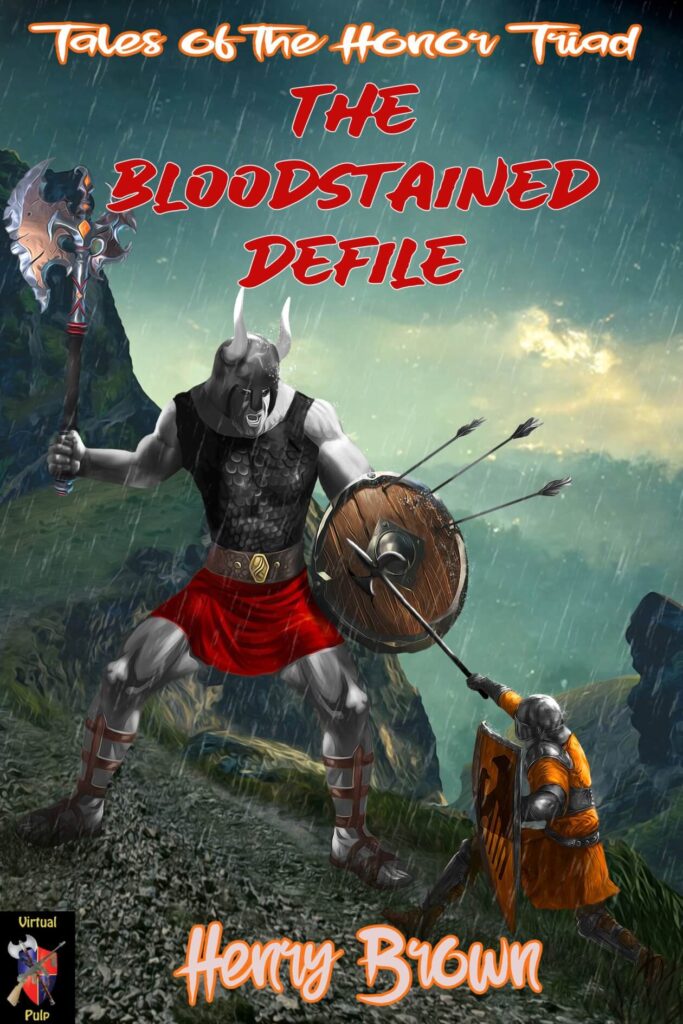
The warriors bore round shields, swords as long as a normal man’s height, enormous
double-bladed axes or spears the size of weaver’s rods. The parts of their bodies not protected by
iron armor, Turgar observed, were covered with white fur. The fur thinned out around their
faces, the skin of which had a greenish tint. Each of them was half again as large as a big man.
Most men were larger than Turgar, but these warriors were titanic.
Unable to access the flanks of the enemy contingent, much less get around to their rear, the
front rank of Dijol’s invasion column were forced to meet them head-on, with nearly even odds.
But even odds were a death sentence against these creatures. Turgar saw a spearman split from
collar to hip with a careless drop of an axe. Next to him, a hammer blow smashed a bronze
helmet and the skull inside it. One Dijolian thrust his spear at a giant’s unprotected knee. A
massive foot pushed the tip down, trapping it against the ground. Simultaneously, a huge hand
seized the spear shaft farther up and pulled. Like a lever, the spear swung its wielder up and
forward, to be skewered on a gigantic sword. Turgar saw these three soldiers die in an instant,
then their bodies added to the size of the death piles.
Twelve warriors were wreaking havoc on an army of thousands, and stalling the conquest of
Fawlik.
“Who are these giants?” Turgar asked.
“They are from the Bruk Islands,” the Captain said.
“Do my eyes see truly–that a tall man’s head is not even as high as their armpits?”
“Verily. And your head would scarcely reach the stomach of those furry, green-skinned
ogres,” quipped an archer, coaxing chuckles from his companions.
Turgar’s bowstring was still dry inside his small wine bladder. But another archer nocked an
arrow, aimed at one of the giant warriors below, and let fly. Such shots were ill-advised in
downpours like this. The rain distorted the vanes and caused erratic trajectories, as it did with
this arrow, which flew so wide of its mark as to cause scornful laughter from its intended target.
Turgar glanced along the ledge and noticed that most quivers were nearly empty.
“With your leave,” Turgar told the Captain, “I’d like to find shelter for my horse.”
The Captain grunted. “You’re certainly welcome to look. Just don’t wander afar. Should the
weather break, I’ll need your bow.”
Of all the archers recruited by Dijol’s army, only those from Gabom were allowed mounts
on every campaign. Their legendary marksmanship was worth the price. Gabomite boys, by their
twelfth summer, could shoot birds on the wing from the saddle of a pony at full gallop. Many,
including Turgar, could perform this feat right or left-handed. But alas, rain was just as much a
bane to him as to any bowman.
Turgar stepped into the stirrups and rode back along the trail he’d taken to reach the
outcropping. Just after the first curve in the path, he found the spot he remembered from his ride
up–a meeting of two boulders. Beyond them was not exactly a trail, but a potential path up the
rough mound of rocks leading perhaps to a crevice or something where his pony and equipment
would be at least partly shielded from the rain. Most horses could never make such a climb. But
then Mountain Wind was not just any horse.
A nudge of heels to ribs and the pony hurtled the junction of the boulders, then picked its
way up the formidable rock with minimal guidance from his rider. They encountered a few more
obstacles which had Mountain Wind blowing by the time they crested a rocky peak to find a
hidden copse in a tiny saddle between three hilltops. The saddle was a natural bowl that collected
enough dirt for not only trees to grow, but shrubs and grass, as well.
Turgar dismounted under the largest tree in the thicket, which deflected most of the rain
with layers of leafy boughs. Mountain Wind snorted, shivered, then tested a mouthful of grass.
Turgar unsaddled him and wiped him dry as best he could.
He noticed the sounds of shouting and steel on steel were even louder now than when he’d
stood with the other archers. He followed the noise out of the grove and up one of the
surrounding peaks. He spied over the rim and saw the battle of the funnel still raging below,
spearmen falling just as fast as they could press in. Turgar was closer now, though just as high
above the scene as before. He considered retrieving his bow and quiver to try a few shots. The
rain would soon leech the resin out of his string, and would interfere with true flight, but his
arrows would hit something–even if not the precise marks he aimed at. Instead he watched the
Bruk Islanders fight.
Their individual tactics were a devastating fusion of skill and savagery. Though they didn’t
move with the agility of many smaller warriors, they were far from slow or clumsy. Turgar had
studied melee combat at every opportunity since boyhood, fascinated at why men would risk life
and limb in such crude butchery instead of just letting arrows settle the matter from a distance
where one still had a sporting chance to survive. These giants of Bruk seemed to fight purely on
instinct, rather than training habits from system-based disciplines–which was the method used
by warriors of Gabom who specialized in melee.
The piles of bodies grew until they merged, blocking the spearmen’s access to the giants.
Officers commanded their men to pull the bodies down and push them into the canyon. So
obliged, a few did try. Huge Bruk spears flicked through the gaps, or down over the piles, and
those soldier’s corpses soon added to the mass of death.
The front spearmen panicked, some dropping weapons, some screaming in despair, but all
turning to flee. Their terror was contagious, and their numbers grew by the scores, then the
hundreds. Many were knocked over the edge into the canyon in the stampede.
Soldiers farther back had not yet seen the horror the front ranks had, and attempted to
physically coerce bravery out of their comrades. Battle broke out among the army of Dijol.
Turgar watched in amused detachment as bedlam consumed the column below, thankful he was
not still down there. It being impossible to tell who was on what side, every man’s spear was
against his neighbor, and more fell over the cliff in the swarming, crashing maelstrom.
Turgar turned his attention back to the Bruk warriors. Tall enough to see the chaos over the
corpse-barrier, they cheered and laughed at the Dijolian mob.
Did they not realize this was only a temporary reprieve? Eventually the weather would clear
and they would fall under a hail of arrows. Or force of numbers would overwhelm them when
the invaders regrouped. Still, he had to admire their mettle. What could Fawlik have possibly
given these men as payment for this suicide mission?
Turgar went back to the archers’ ledge periodically to report to the Captain, and to take
water and rations. He slept the afternoon away, relatively dry under the tree with Mountain
Wind, but awoke after nightfall.
His pupils widened in the dark, bringing into sharp definition all the shapes around him, if
not the colors.
He left his secret shelter to climb the peak and view the funnel again.
The battle amongst the spearmen had spent itself but the army, soaked, exhausted and
demoralized, had fallen back beyond the mouth of the pass, leaving only a skeleton force to keep
watch on the Bruk Islanders. The giants mostly dozed in full armor under sealskin capes,
standing watch in shifts.
Turgar returned to his shelter and indulged in some wine before drifting off to sleep,
wondering whether the next day would bring victory, or just more rain.
***
Javo opened his tent flap at dawn and surveyed the landscape. Rain had slowed to a drizzle.
The army had only two choices as he saw it: Retreat, regroup, and choose another invasion
route; or use this slackening in the weather to press the attack at any cost, before sickness began
spreading in the waterlogged ranks.
But Javo had no say in the matter. He marched with the Army of Dijol for only one
contingency, and that one might never be implemented on this campaign.
When General Tral’s runner visited his tent, he knew implementation was forthcoming.
Leaving his armor in the care of the Dijolian squire assigned him, Javo dressed in a hide
tunic and trousers and wrapped himself in a cape to fend off the drizzle. Javo stood a head taller
than most men. His jet-black shock of hair, bronze complexion and hawk-like features were
typical of Cemarites, though mercenary employment was not.
That Javo enjoyed full membership in an order as prestigious and renowned as the Black
Lancers would be of little moment in Cemar, where caste and hierarchy and regimentation were
traditionally scorned.
The runner escorted him to General Tral’s tent, where he was ushered in immediately. Most
generals, Tral included, customarily kept men waiting outside, even during inclement weather, as
a reminder of who outranked whom. But no general tried this with a Black Lancer.
The command tent was crowded inside. Tral’s legion commanders sat facing him, on chairs
lower than his. But a robed figure stood behind Tral, still as a pillar, features hidden in the
shadow of the hood.
A parchment map lay spread on the table at the center of the tent. At either side of Tral’s
chair were thick wooden poles thrust in the ground. From one pole hung the banner of Dijol,
from the other, the army guidon with Tral’s family crest.
The map told the story of Dijol’s war with Fawlik: Much larger and boasting a far more
powerful armada, Dijol nevertheless faced formidable terrain in the conquest of her neighbor.
The most appealing invasion route was also the most obvious–along the Tyrn Valley where they
would be attacking downhill. But a Dijolian army had met catastrophe there a generation ago
when the Fawlikites dammed the river, flooding the valley and masking the patchwork of pitfalls
they’d dug. Dijol’s heavy cavalry bogged down in the muddy quagmire, while Fawlik’s archers
emerged from the forest to pour arrows in from the flanks. Artillery batteries brought up
catapults to hammer at the following infantry. When the invaders finally made it past the dam,
disorganized and weakened, fresh Fawlikite infantry and cavalry swooped upon them and,
though still outnumbered, fought them to a standstill. It was the costliest setback in Dijol’s
history.
This time, Dijol invaded along the same valley, while General Tral simultaneously
attempted to sneak his larger force through this narrow mountain pass to take Fawlik’s king by
surprise and force a swift, almost bloodless surrender. Unable to spare even a phalanx from their
main force in the Tyrn Valley, Fawlik evidently hired a small band of Bruk Islanders for a
delaying action in case someone did send a force through the pass.
“Sir Javo,” greeted Tral, “welcome.”
Tral didn’t stand, but Javo saluted him perfunctorily anyway. Tral was a thick, bald man of
the age to have many grandchildren. His eyes were cold gray orbs, always measuring, counting
or otherwise calculating. “You know why you were summoned.” This was not a question but a
simple statement, assuming shared knowledge.
“The Brukites have agreed to single combat?” Javo asked.
The hooded figure behind Tral shifted slightly, though its exact posture was still difficult to
discern through the loose folds of the burgundy robe.
“Perhaps,” Tral said, smiling with his mouth but not his eyes. “But first, we need you to
negotiate with them.”
Javo inclined his head, eyebrows arching.
“You heard what happened yesterday,” Tral said. “My commanders estimate over 2,000
dead and wounded. We are a day behind schedule, have lost the element of surprise, and the rain
will likely grow heavy again by mid morning.”
Javo had noticed the dark clouds upwind, too. Even if the numbers were exaggerated by
pessimism…not a characteristic Dijolian trait…how could a score of men, even men of Bruk,
have slain 2,000?
“We need a truce with these Brukites,” Tral said.
“I’m a knight,” Javo said. “A Lancer. Skilled in battle, not diplomacy.”
The robed figure spoke in a soft, effeminate voice, gesturing with smooth, circular motions
of its delicate hands. “The Bruk Islanders are warriors, young knight. They are a nation of
sailors, explorers, and adventurers. They trust no diplomats, envoys or anyone of a profession
they consider less…robust.”
“This camp is full of soldiers,” Javo said. “This tent is full of high-ranking ones, who, no
doubt, are as deft with tongues as with swords.”
Tral’s officers muttered and grunted. Nothing intelligible.
“None of them bear the mark of the Black Lancers,” said the effeminate voice from under
the burgundy hood.
On the back of Javo’s neck was the famous brand, burned into his neck on the day he was
knighted. Few were the occasions he needed to show it, but there were places all over the world
it served as a passport, a badge of immunity, or a license for free food, drink, women, lodging or
medical treatment. Once accepted into the Order of the Black Lancers, a knight was a Lancer for
life, even after he aged beyond the ability to ride and fight with the elite. The reputation of the
Lancers was better than a merchant’s gold to most folk. The Order transcended nationality, but
only accepted squires with honor above reproach, and only the best of those squires survived the
Crucible and were awarded the black lance and armor. Their oath to honor is what dissuaded
many from committing to the Order. It bound them to fair and forthright behavior, no matter the
circumstance, even during war.
“Who are you?” Javo asked.
“I am the counsel of wisdom,” replied the robed one.
Javo resisted the urge to sidestep General Tral and tug the person’s hood back, if for no
other reason than to determine if it was man or woman.
“Albumor is my advisor,” Tral said, patiently.
“You are Cemarite,” Albumor said. “Does Cemar and its surrounding farmlands not boast
more traders, merchants and great thinkers than any other nation? Surely negotiation is not alien
to you.”
Javo sighed. He had accepted this contract, and he supposed diplomatic assignments did not
violate it. “What are the terms of the truce?”
“They are free to leave in peace, with twenty pieces of gold for each man,” Tral said. “Or
they can join my army for double the normal rate of mercenary pay.”
“And should they recite any of their platitudes about loyalty, destiny or death,” Albumor
added, “challenge them to choose a champion and meet you in single combat.”
Reviews
There are no reviews yet.